
Follow us:
Clients

Choosing the right hosting solution is one of the most important decisions when building or growing a website. A hosting platform affects your site’s performance, security, scalability, and overall user experience.
Two options that often create confusion are cloud hosting and WordPress hosting. While both can support a successful website, they are designed for different needs and use cases.
Understanding the differences between cloud hosting vs WordPress hosting can help you choose the solution that aligns with your goals today while supporting future growth.
Understanding Cloud Hosting
Cloud hosting uses a network of interconnected servers to host websites, applications, and data. Instead of relying on a single physical server, resources are distributed across multiple servers, providing greater flexibility and resilience.
If one server experiences an issue, another server within the network can continue supporting the workload. This design helps improve uptime and performance.
Many businesses choose cloud hosting for WordPress because it provides scalability and the ability to handle changing traffic demands without major infrastructure changes.
Benefits of Cloud Hosting
One of the biggest advantages of cloud hosting is scalability. Resources such as CPU, memory, and storage can often be adjusted as demand changes.
Cloud hosting also provides:
● High availability and redundancy
● Better performance during traffic spikes
● Flexible resource allocation
● Strong disaster recovery capabilities
● Support for multiple applications and websites
For businesses expecting growth or unpredictable traffic patterns, cloud hosting can provide the flexibility needed to adapt quickly.
Understanding WordPress Hosting
WordPress hosting is specifically optimized for websites built with WordPress. The hosting environment is configured to improve compatibility, performance, and ease of management for WordPress users.
Unlike general hosting environments, WordPress hosting often includes features tailored specifically to the platform.
These features may include:
● One-click WordPress installation
● Automatic WordPress updates
● WordPress-specific security measures
● Performance optimizations
● Managed backups
For website owners who primarily use WordPress and want simplified experience, WordPress hosting can reduce administrative tasks and technical complexity.
Benefits of WordPress Hosting
The main advantage of WordPress hosting is convenience.
Because the environment is optimized specifically for WordPress, users often benefit from:
● Faster setup and deployment
● Simplified website management
● Improved WordPress performance
● Enhanced WordPress security
● Easier maintenance
This makes WordPress hosting attractive for bloggers, small businesses, content creators, and organizations that want a straightforward hosting solution.
Cloud Hosting vs WordPress Hosting: Key Differences
While both solutions can host a WordPress website, they are designed with different priorities in mind.
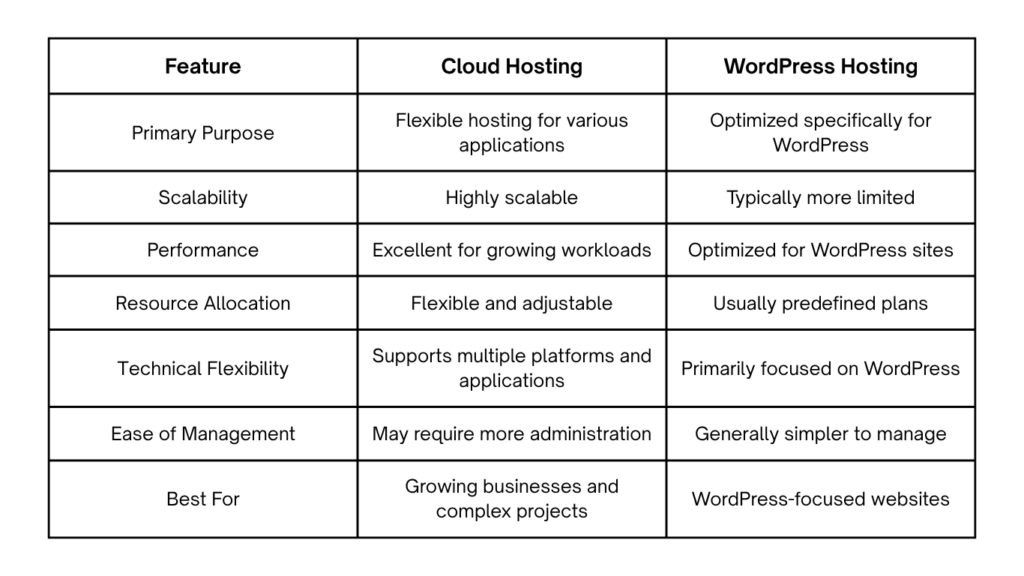

The comparison highlights an important point: one solution is not automatically better than the other. The best choice depends on your goals and technical requirements.
Which Option Is Better for Small Businesses?
For many small businesses, the answer depends on how the website is being used.
If the website serves primarily as a marketing platform, company website, or blog built entirely on WordPress, WordPress hosting may provide everything needed with less complexity.
However, businesses planning future expansion, custom applications, e-commerce growth, or multiple websites may find cloud hosting offers greater flexibility.
Think of it like transportation.
WordPress hosting is like owning a vehicle designed for a specific purpose. It performs that role efficiently and requires little customization.
Cloud hosting is more like owning a fleet of adaptable vehicles. It provides more options and room to grow but may require additional planning and management.
When Should You Choose Cloud Hosting?
Cloud hosting may be the better choice if:
● Your website experiences fluctuating traffic
● You expect significant business growth
● You run multiple websites or applications
● Scalability is a priority
● High availability is important
Organizations that require flexibility often benefit from cloud infrastructure because resources can grow alongside business demands.
When Should You Choose WordPress Hosting?
WordPress hosting may be ideal if:
● Your website is built entirely on WordPress
● You prefer a simpler hosting experience
● You want automated WordPress maintenance
● You have limited technical resources
● Your website has predictable traffic patterns
Many small businesses and bloggers appreciate the simplicity and platform-specific optimization that WordPress hosting provides.
Businesses looking for affordable website hosting solutions often start with shared hosting plans designed for WordPress websites.
Choosing the Hosting Solution That Supports Your Goals
The debate around WordPress hosting vs cloud hosting is not about finding a universal winner. Instead, it is about selecting the hosting environment that best meets your website’s requirements.
Cloud hosting offers scalability, flexibility, and resilience. WordPress hosting offers simplicity, optimization, and ease of management.
By evaluating your website’s current needs and future growth plans, you can make a decision that supports both performance and long-term success.
Finding the Right Hosting Solution for Your Website
Whether you choose cloud hosting or WordPress hosting, the goal is the same: providing reliable and efficient experience for your visitors.
If you are unsure which option best fits your website, take time to evaluate your traffic expectations, growth plans, technical requirements, and budget. The right hosting environment can improve performance, simplify management, and provide a stronger foundation for future growth. Explore SoftSys Hosting solutions to find a hosting option that aligns with your business goals and supports your website as it evolves.