
Follow us:
Clients
Starting and growing a business comes with enough challenges, technology shouldn’t be one of them. For startups and small businesses, cloud hosting has become the preferred foundation for building reliable, scalable, and cost-effective IT environments.
Cloud hosting removes the need for heavy upfront investments, complex infrastructure management, and rigid capacity planning. Instead, it gives businesses the flexibility to grow, adapt, and compete in a digital-first world.
This article explains why cloud hosting for startups and cloud hosting for small businesses is not just a trend, but a smart long-term strategy.

What Is Cloud Hosting?
Cloud hosting uses a network of virtual servers to store, manage, and deliver applications and data. Instead of relying on a single physical server, resources are distributed across multiple servers, ensuring higher availability, performance, and resilience.
For small organizations, cloud server hosting for small businesses means access to enterprise-grade infrastructure without enterprise-level costs or complexity.
Key Reasons Cloud Hosting Is Ideal for Startups and Small Businesses
1. Lower Upfront Costs and Predictable Pricing
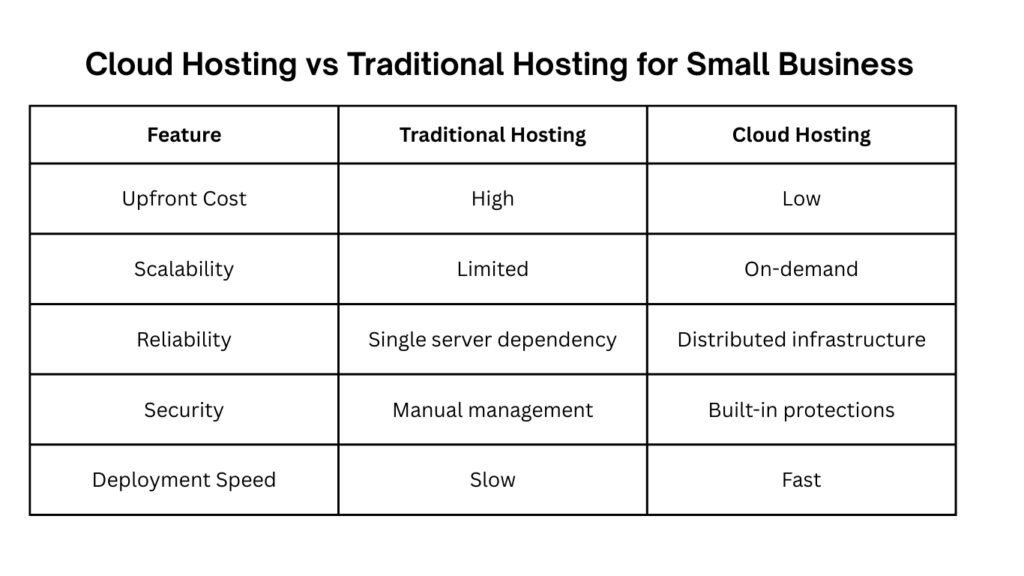
One of the biggest advantages of cloud hosting for startups is cost efficiency. There’s no need to purchase physical servers, networking equipment, or expensive licenses upfront.
With cloud hosting:
● You pay only for the resources you use
● Costs scale gradually as your business grows
● Budgeting becomes more predictable
This makes cloud hosting for small businesses especially appealing when cash flow and financial flexibility matter most.
2. Easy Scalability as Your Business Grows
Growth is unpredictable, especially for startups. Cloud hosting allows businesses to scale resources up or down in minutes.
Benefits include:
● No downtime when adding capacity
● No overpaying for unused infrastructure
● Ability to handle traffic spikes or seasonal demand
This flexibility ensures your technology never becomes a bottleneck to growth.
3. Improved Reliability and Business Continuity
Cloud platforms are built with redundancy in mind. If one server or data center experiences an issue, workloads are automatically shifted to another location.
For small businesses, this means:
● Reduced downtime
● Higher availability for applications and websites
● Built-in disaster recovery capabilities
Cloud hosting helps protect your operations from unexpected disruptions.

4. Strong Security Without Internal Complexity
Modern cloud providers invest heavily in security, often far more than a small business could on its own.
Cloud hosting typically includes:
● Data encryption
● Secure access controls
● Regular security updates and monitoring
● Compliance-ready infrastructure
This makes cloud server hosting for small businesses a safer option than unmanaged on-premise systems.
5. Faster Deployment and Innovation
Cloud hosting enables businesses to launch websites, applications, and services quickly.
Instead of waiting weeks or months for infrastructure setup, startups can:
● Deploy environments in minutes
● Test new ideas with minimal risk
● Iterate faster and respond to market changes
Speed is a competitive advantage—and cloud hosting delivers it.
6. Reduced IT Management Burden
Small teams don’t always have dedicated IT staff. Cloud hosting simplifies infrastructure management through automation, dashboards, and managed services.
This allows business owners and teams to:
● Focus on customers and growth
● Spend less time on server maintenance
● Avoid complex hardware troubleshooting
Cloud hosting supports productivity, not distraction.
Who Should Consider Cloud Hosting?
Cloud hosting is ideal for:
● Startups launching digital products
● Small businesses running websites or applications
● Companies planning growth but needing cost control
● Organizations that value uptime and security
Whether you’re just starting out or scaling operations, cloud hosting for small businesses offers a strong foundation for long-term success.
The Role of Cloud Hosting in Modern Business Growth
Cloud hosting removes traditional barriers to entry and empowers startups and small businesses with flexible, secure, and scalable infrastructure. It allows companies to focus on innovation and customers rather than servers and maintenance.
As digital demands continue to grow, cloud hosting is no longer optional, it’s essential.
If you’re evaluating cloud hosting for your startup or small business, the right setup can make a meaningful difference in performance, cost control, and reliability. Speak with a cloud hosting specialist to assess your current needs, plan for growth, and choose a solution that supports your business today and as it scales.