
Follow us:
Clients
Choosing the right hosting infrastructure is one of the most important technology decisions a business can make. The hosting environment you select impacts website performance, application reliability, scalability, security, and long-term costs.
Two of the most common options available today are the dedicated server and the cloud server. Both are powerful solutions capable of supporting business-critical workloads, but they are designed to solve different challenges.
When evaluating a dedicated server or cloud environment, it is important to understand how each solution works, what benefits they offer, and which option best aligns with your business goals.
Understanding Dedicated Servers
A dedicated server is a physical machine assigned exclusively to a single customer. Unlike shared hosting or VPS environments, all server resources belong to one organization.
This means the server’s CPU, memory, storage, and network capacity are not shared with anyone else.
Think of a dedicated server like owning a private office building. You have complete control over the space, how it is configured, and how resources are used. There are no neighboring businesses competing for power, space, or infrastructure.
This level of exclusivity makes dedicated servers attractive for organizations that require predictable performance, advanced customization, and enhanced security.
Benefits of Dedicated Servers
Dedicated servers provide several advantages:
● Exclusive access to all server resources
● Consistent performance under heavy workloads
● Greater security through isolated infrastructure
● Full control over server configuration
● Support for specialized applications and software
● Predictable resource availability
Businesses with large databases, high-traffic websites, enterprise applications, or strict compliance requirements often choose dedicated hosting because of these benefits.
Understanding Cloud Servers
A cloud server operates differently. Instead of relying on a single physical machine, cloud infrastructure uses a network of interconnected servers that work together.
Resources can be allocated dynamically based on demand. If additional processing power or storage is needed, the cloud environment can often scale without requiring new hardware.
A useful analogy is comparing a cloud server to using ride-sharing services instead of owning a vehicle. You use the resources you need when you need them, without being tied to a single physical asset.
This flexibility makes cloud servers popular among businesses with changing workloads and growth plans.
Benefits of Cloud Servers
Cloud servers offer several important advantages:
● Flexible resource scaling
● High availability through distributed infrastructure
● Faster deployment of new environments
● Ability to handle traffic spikes efficiently
● Pay-for-use pricing models in many cases
● Simplified expansion as business needs change
Organizations that experience seasonal demand fluctuations or rapid growth often benefit from cloud infrastructure.
Dedicated Server vs. Cloud Server: Key Differences
Although both solutions provide powerful hosting environments, they are designed around different priorities.
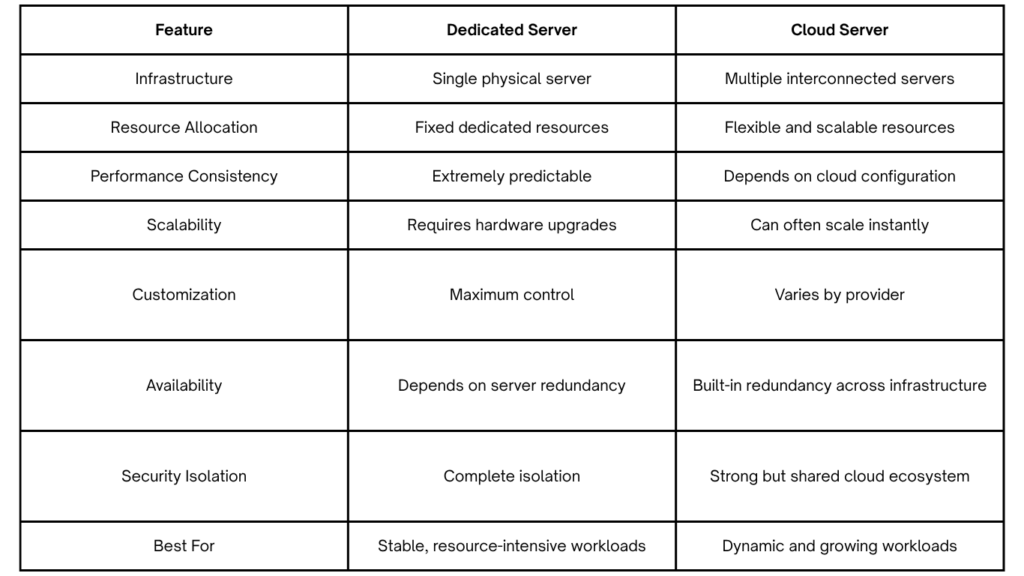
This comparison illustrates that neither solution is universally better. The right choice depends on how your business operates and what challenges you need to solve.

When a Dedicated Server Makes More Sense
A dedicated server is often the better choice when performance consistency is critical.
For example, imagine running a large e-commerce platform during major sales events. Predictable server performance can be more important than rapid scalability because every second of downtime or slow response impacts revenue.
Dedicated servers are commonly selected when:
● Applications require guaranteed resources
● Security and compliance are top priorities
● Custom software configurations are needed
● Workloads remain relatively stable
● Performance consistency is essential
Organizations that require complete control over their environment often prefer dedicated infrastructure because it eliminates resource-sharing concerns. Businesses seeking high-performance dedicated server hosting solutions frequently choose dedicated environments for mission-critical workloads.
When a Cloud Server Makes More Sense
Cloud servers excel when flexibility and scalability are priorities.
Consider a growing startup launching a new application. Traffic may be unpredictable, and future resource requirements are difficult to estimate.
In this scenario, cloud infrastructure allows the business to scale resources as demand changes without investing in additional hardware.
Cloud servers are often ideal when:
● Workloads fluctuate significantly
● Rapid growth is expected
● Multiple environments are needed quickly
● Geographic redundancy is important
● Resource flexibility is a priority
For businesses that value adaptability, cloud hosting provides the ability to evolve without major infrastructure changes.
The Real Question: Dedicated Server or Cloud?
The debate is not about which technology is superior.
The real question is which solution aligns better with your operational needs.
If your business prioritizes predictable performance, complete control, and infrastructure isolation, a dedicated server may be the better fit.
If flexibility, rapid scaling, and infrastructure agility are more important, a cloud server may provide greater value.
Many organizations even use a hybrid approach, leveraging dedicated servers for critical workloads while using cloud infrastructure for scalable services.
Making the Right Infrastructure Decision
Choosing between a dedicated server and a cloud server should be based on your business objectives rather than industry trends.
Evaluate your expected traffic, application requirements, security needs, compliance obligations, and growth projections. Understanding these factors will help determine
which hosting environment can best support your operations both today and in the future.
The right infrastructure is not simply about technology, it is about creating a reliable foundation for business success.
Ready to Build on a Stronger Hosting Foundation?
Whether your business requires the predictable performance of a dedicated server or the flexibility of cloud infrastructure, selecting the right hosting solution can significantly impact your growth, security, and operational efficiency.
Take the time to assess your current needs and plans. The right hosting environment should not only support your business today but also provide the stability and scalability required for tomorrow. Explore your options with SoftSys Hosting and choose an infrastructure solution designed to help your business perform at its best.